Artificial Intelligence has evolved from a futuristic concept to a practical business necessity, fundamentally transforming how enterprises operate, compete, and innovate. In today’s hyper-competitive digital landscape, AI is no longer just an optional technology—it’s become a critical component of enterprise strategy, driving efficiency, innovation, and competitive advantage across every industry sector. From automating routine tasks to enabling sophisticated predictive analytics, AI is reshaping enterprise processes in ways that were unimaginable just a decade ago.
The significance of AI in enterprise contexts extends far beyond simple automation. It represents a paradigm shift in how businesses approach problem-solving, decision-making, and customer engagement. As enterprises grapple with increasing data volumes, complex supply chains, and evolving customer expectations, AI provides the intelligent framework needed to navigate these challenges effectively. This blog post explores the comprehensive uses and applications of AI in enterprise processes, examining both the transformative benefits and practical implementation considerations that every business leader should understand in 2025.
Understanding AI in Enterprise Contexts
Before diving into specific applications, it’s essential to understand what constitutes AI in enterprise settings. Enterprise AI refers to the application of artificial intelligence technologies—including machine learning, natural language processing, computer vision, and robotic process automation—to solve business problems, optimize operations, and create value at scale. Unlike consumer-facing AI applications, enterprise AI focuses on reliability, scalability, security, and integration with existing business systems.
The foundation of enterprise AI rests on three core pillars: data infrastructure, algorithmic intelligence, and business integration. Successful implementations require robust data pipelines, appropriate machine learning models, and seamless integration with enterprise resource planning (ERP), customer relationship management (CRM), and other business systems. This holistic approach ensures that AI delivers measurable business outcomes rather than functioning as isolated technology experiments.
Top 10 Enterprise AI Applications and Their Transformative Impact
1. Intelligent Process Automation (IPA):
Combining robotic process automation with AI capabilities, IPA automates complex business processes that require decision-making, pattern recognition, and learning. Use cases include invoice processing, claims adjudication, and customer onboarding. Notable users include major financial institutions like JPMorgan Chase and insurance companies like Allstate. Benefits include 40-70% reduction in processing time and significant error reduction, though implementation requires careful process mapping and change management.
2. Predictive Analytics and Forecasting:
AI-powered predictive models analyze historical data to forecast future trends, demand patterns, and potential risks. Applications span inventory optimization, sales forecasting, and maintenance scheduling. Companies like Amazon and Walmart use these systems extensively for supply chain optimization. The primary benefit is improved decision-making accuracy, though challenges include data quality requirements and model interpretability.
3. Customer Service Automation:
AI chatbots and virtual assistants handle routine customer inquiries, provide personalized recommendations, and escalate complex issues to human agents. Use cases include 24/7 customer support, order tracking, and personalized marketing. Companies like Zendesk and Salesforce integrate these solutions. Benefits include reduced response times and improved customer satisfaction, with limitations around handling nuanced emotional interactions.
4. Fraud Detection and Security:
Machine learning algorithms analyze transaction patterns in real-time to identify anomalies and potential fraudulent activities. Applications include credit card fraud detection, cybersecurity threat identification, and compliance monitoring. Financial institutions like Mastercard and cybersecurity firms like CrowdStrike employ these systems. Benefits include reduced financial losses and enhanced security, though false positives remain a challenge.
5. Supply Chain Optimization:
AI algorithms optimize logistics, inventory management, and distribution networks by analyzing multiple variables simultaneously. Use cases include route optimization, demand forecasting, and warehouse automation. Companies like FedEx and DHL have implemented these solutions. Benefits include reduced operational costs and improved delivery efficiency, with implementation complexity as a potential drawback.
6. Human Resources and Talent Management:
AI-powered systems streamline recruitment, employee engagement, and performance management. Applications include resume screening, skills gap analysis, and personalized learning recommendations. Companies like IBM and Unilever use these tools. Benefits include reduced hiring bias and improved talent retention, though ethical considerations around algorithmic bias require careful attention.
7. Quality Control and Manufacturing:
Computer vision and machine learning systems inspect products, predict equipment failures, and optimize production processes. Use cases include defect detection, predictive maintenance, and production line optimization. Manufacturers like Siemens and General Electric implement these solutions. Benefits include reduced waste and improved product quality, with initial setup costs to consider.
8. Personalized Marketing and Sales:
AI analyzes customer behavior to deliver targeted marketing campaigns and sales recommendations. Applications include customer segmentation, content personalization, and lead scoring. Companies like Netflix and Spotify famously use these systems. Benefits include increased conversion rates and customer engagement, though privacy concerns must be addressed.
9. Document Processing and Management:
Natural language processing and optical character recognition automate document classification, extraction, and analysis. Use cases include contract review, compliance documentation, and research analysis. Legal firms and pharmaceutical companies increasingly adopt these solutions. Benefits include reduced manual processing time and improved accuracy, with challenges around handling unstructured data.
10. Energy Management and Sustainability:
AI optimizes energy consumption, predicts maintenance needs for renewable energy systems, and manages carbon footprint. Applications include smart grid management, building energy optimization, and emissions tracking. Companies like Schneider Electric and Tesla implement these solutions. Benefits include reduced energy costs and improved sustainability metrics, with integration complexity as a potential barrier.
Key Benefits of AI Implementation in Enterprises
The benefits of AI in enterprise processes extend across multiple dimensions, creating value that compounds over time. Operational Efficiency stands as the most immediate benefit, with AI automating repetitive tasks, reducing errors, and accelerating processes. Studies show that enterprises implementing AI automation typically achieve 30-50% improvements in operational efficiency within the first year.
Enhanced Decision-Making
It represents another critical benefit, as AI systems process vast amounts of data to provide insights that would be impossible for human analysts to derive manually. Predictive analytics and prescriptive recommendations enable data-driven decision-making at unprecedented speed and accuracy. This capability becomes particularly valuable in dynamic markets where rapid response to changing conditions determines competitive success.
Cost Reduction and Resource
Optimization emerges as a significant financial benefit. AI-driven optimization reduces waste, minimizes downtime, and allocates resources more effectively. In manufacturing, predictive maintenance alone can reduce maintenance costs by 20-30% while extending equipment lifespan. In customer service, AI automation reduces staffing requirements for routine inquiries while improving service quality.
Innovation and Competitive Advantage
It represents strategic benefits that extend beyond immediate operational improvements. AI enables enterprises to develop new products, enter new markets, and create novel business models. Companies that successfully integrate AI into their core operations often establish sustainable competitive advantages that are difficult for competitors to replicate, creating barriers to entry in their respective markets.
Choosing the Right AI Solutions: A Strategic Framework
Selecting appropriate AI solutions requires careful consideration of multiple factors. Begin by assessing business needs and objectives—identify specific pain points, desired outcomes, and measurable success criteria. Avoid technology-first approaches; instead, focus on business problems that AI can solve effectively. Consider both immediate needs and long-term strategic goals to ensure scalability and future relevance.
Evaluate data readiness and infrastructure
AI solutions depend on quality data. Assess your data collection processes, storage infrastructure, and data governance practices. Ensure you have sufficient, relevant, and clean data to train and maintain AI models. Consider both structured data (databases, spreadsheets) and unstructured data (documents, emails, social media) that might be relevant to your use cases.
Consider implementation complexity and resource requirements
Different AI solutions vary significantly in their implementation demands. Some require specialized data science expertise, while others offer no-code/low-code platforms. Assess your internal capabilities, budget constraints, and timeline requirements. For enterprises new to AI, starting with pre-built solutions or partnering with experienced vendors often proves more effective than building from scratch.
Prioritize integration and scalability
ensure that AI solutions integrate seamlessly with existing enterprise systems (ERP, CRM, etc.). Consider both technical integration (APIs, data formats) and organizational integration (workflow changes, user adoption). Plan for scalability from the beginning, considering how solutions will handle increasing data volumes, user counts, and business complexity over time.
Implementation Best Practices and Common Pitfalls
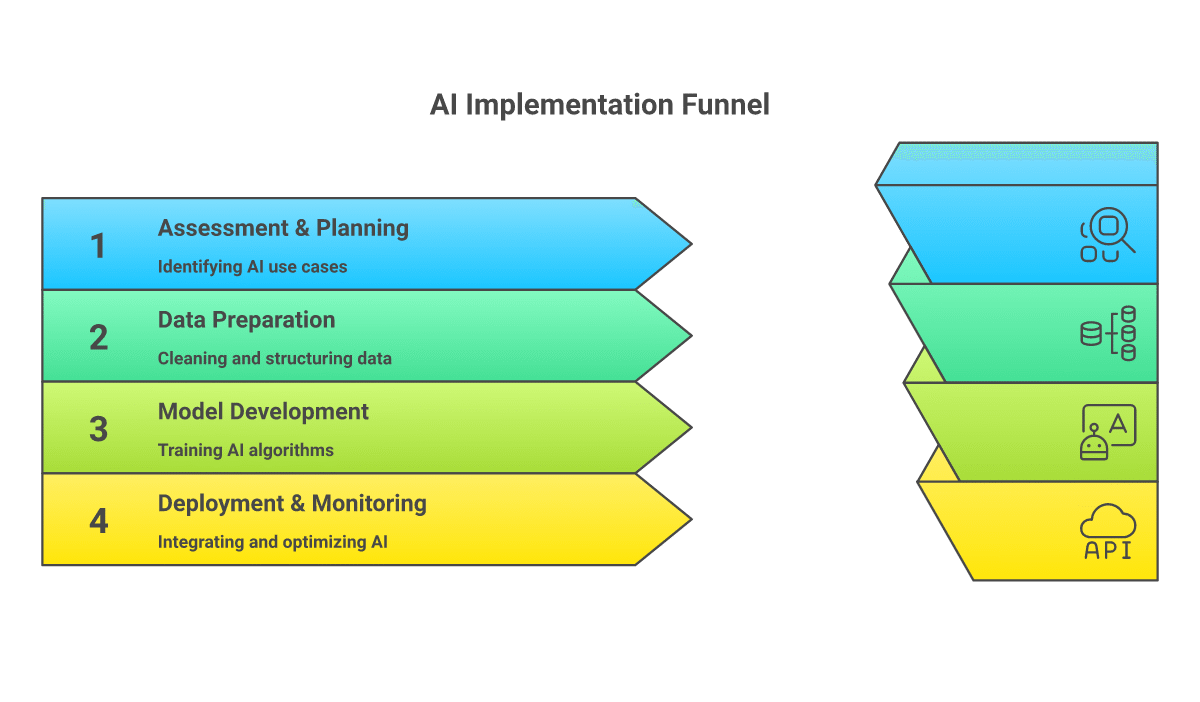
Successful AI implementation follows established best practices while avoiding common pitfalls. Start with pilot projects—begin with small, well-defined use cases that demonstrate value quickly. These pilot projects should have clear success metrics, manageable scope, and executive sponsorship. Successful pilots build organizational confidence and provide valuable learning experiences for larger implementations.
Focus on change management and user adoption
Technical implementation represents only part of the challenge. Prepare your organization for AI adoption through comprehensive training, clear communication about benefits, and involvement of end-users in the design process. Address concerns about job displacement transparently, emphasizing how AI augments human capabilities rather than replacing them entirely.
Establish governance and ethical frameworks
Develop clear policies around data privacy, algorithmic transparency, and ethical AI use. Implement regular audits of AI systems to ensure fairness, accuracy, and compliance with regulations. Consider establishing an AI ethics committee or similar governance structure to oversee implementation and address emerging ethical concerns.
Avoid common pitfalls, including unrealistic expectations (AI is not magic), insufficient data preparation, neglecting maintenance requirements, and underestimating integration complexity. Remember that AI systems require ongoing monitoring, retraining, and optimization to maintain effectiveness as business conditions and data patterns evolve.
Conclusion: The Future of AI in Enterprise Excellence
The integration of AI into enterprise processes represents one of the most significant technological transformations of our era. As we’ve explored, the uses and applications of AI span every business function, from operations and customer service to innovation and strategic planning. The benefits of AI—including improved efficiency, enhanced decision-making, cost reduction, and competitive advantage—are compelling reasons for enterprises to embrace this technology.
Looking forward, AI will continue to evolve from discrete applications to integrated enterprise intelligence platforms. The most successful organizations will be those that view AI not as a standalone technology but as a fundamental capability woven into their operational fabric. By approaching AI implementation strategically, focusing on business value, and maintaining ethical standards, enterprises can harness AI’s transformative power to achieve sustainable growth and excellence in an increasingly complex business environment.
The journey toward AI-enabled enterprise excellence requires commitment, investment, and continuous learning. However, the rewards—in terms of operational efficiency, innovation capacity, and competitive positioning—make this journey not just worthwhile but essential for enterprises seeking to thrive in the digital age. As AI technologies continue to advance, enterprises that embrace these capabilities today will be best positioned to lead their industries tomorrow.