
JavaScript Frameworks for Enterprise Applications: Choosing the Right Architecture for Scaling in 2026,
Introduction: The Enterprise JavaScript Landscape in 2026
As we approach 2026, the choice of JavaScript frameworks for enterprise applications has become more critical than ever. The architectural decisions you make today will determine your application’s scalability, maintainability, and performance for years to come. In an era where digital transformation accelerates and user expectations continue to rise, selecting the right framework isn’t just about current needs—it’s about future-proofing your enterprise applications.
The debate between microservices and monolithic architectures directly impacts framework selection. While architecture determines how your application is structured, the JavaScript framework you choose dictates how effectively you can implement that architecture. This guide explores the top JavaScript frameworks specifically tailored for enterprise applications in 2026, helping you make informed decisions that balance scalability, developer productivity, and long-term maintainability.
Understanding Enterprise Framework Requirements
Enterprise applications have unique requirements that distinguish them from smaller projects. These applications typically serve thousands or millions of users, require high availability, need robust security measures, and must integrate with numerous backend systems. The ideal JavaScript framework for enterprise applications must excel in several key areas: scalability, maintainability, performance, security, and developer ecosystem.
Scalability is particularly crucial. A framework must handle increasing loads gracefully, whether through server-side rendering, code splitting, or efficient state management. Maintainability ensures that large development teams can work collaboratively without creating technical debt. Performance directly impacts user experience and conversion rates, while security is non-negotiable for enterprise applications handling sensitive data. Finally, a strong ecosystem with comprehensive tooling, documentation, and community support accelerates development and reduces risk.
Top JavaScript Frameworks for Enterprise Applications in 2026
1. React with Next.js: The Full-Stack Powerhouse – React continues to dominate enterprise development, and when paired with Next.js, it becomes a comprehensive solution for large-scale applications. Next.js provides server-side rendering, static site generation, and API routes out of the box, making it ideal for both monolithic and microservices architectures. Notable users include Netflix, Airbnb, and Uber. Pros: Excellent ecosystem, strong TypeScript support, flexible architecture. Cons: Steeper learning curve for full-stack implementation.
2. Angular: The Enterprise-Ready Framework – Google’s Angular remains a top choice for large enterprise applications requiring structure and consistency. Its opinionated architecture, built-in dependency injection, and comprehensive tooling make it particularly suitable for teams working on complex applications with strict coding standards. Used by Google, Microsoft, and IBM. Pros: Complete solution with routing, forms, and HTTP client included; excellent for large teams. Cons: Larger bundle size; less flexibility compared to React.
3. Vue 3 with Nuxt.js: The Progressive Framework – Vue’s gentle learning curve combined with Nuxt.js’s powerful features makes this combination increasingly popular for enterprise applications. Vue 3’s Composition API provides excellent TypeScript support and better code organization for large codebases. Used by Alibaba, BMW, and Nintendo. Pros: Excellent performance, progressive adoption, strong documentation. Cons: Smaller enterprise ecosystem compared to React and Angular.
4. Svelte with SvelteKit: The Compiler Approach – Svelte’s innovative approach of compiling components at build time results in exceptionally small bundle sizes and excellent performance. SvelteKit provides the full-stack capabilities needed for enterprise applications. While newer to the enterprise scene, it’s gaining traction for performance-critical applications. Pros: Minimal runtime, excellent performance, clean syntax. Cons: Smaller community, fewer enterprise-ready libraries.
5. Remix: The Full-Stack Framework – Built by the creators of React Router, Remix focuses on web fundamentals and provides excellent developer experience for full-stack applications. Its nested routing and data loading patterns make it particularly suitable for complex enterprise applications with multiple data sources. Pros: Excellent performance, built-in error boundaries, progressive enhancement. Cons: Relatively new, smaller ecosystem.
Framework Comparison: Key Metrics for Enterprise Decisions
When evaluating JavaScript frameworks for enterprise applications, consider these critical metrics: Bundle size impacts initial load time and user experience—Svelte typically leads here. Learning curve affects onboarding time and development velocity—Vue offers the gentlest introduction. Ecosystem size determines available libraries and community support—React dominates this category. TypeScript support is crucial for large teams—all major frameworks now offer excellent TypeScript integration.
Performance benchmarks show that while raw rendering speed matters, the overall user experience depends more on intelligent code splitting, efficient data fetching, and proper caching strategies. Server-side rendering frameworks like Next.js and Nuxt.js excel at providing fast initial page loads, while client-side frameworks can offer smoother subsequent interactions. The choice often depends on your specific use case and user behavior patterns.
Architecture Considerations: Microservices vs Monolithic
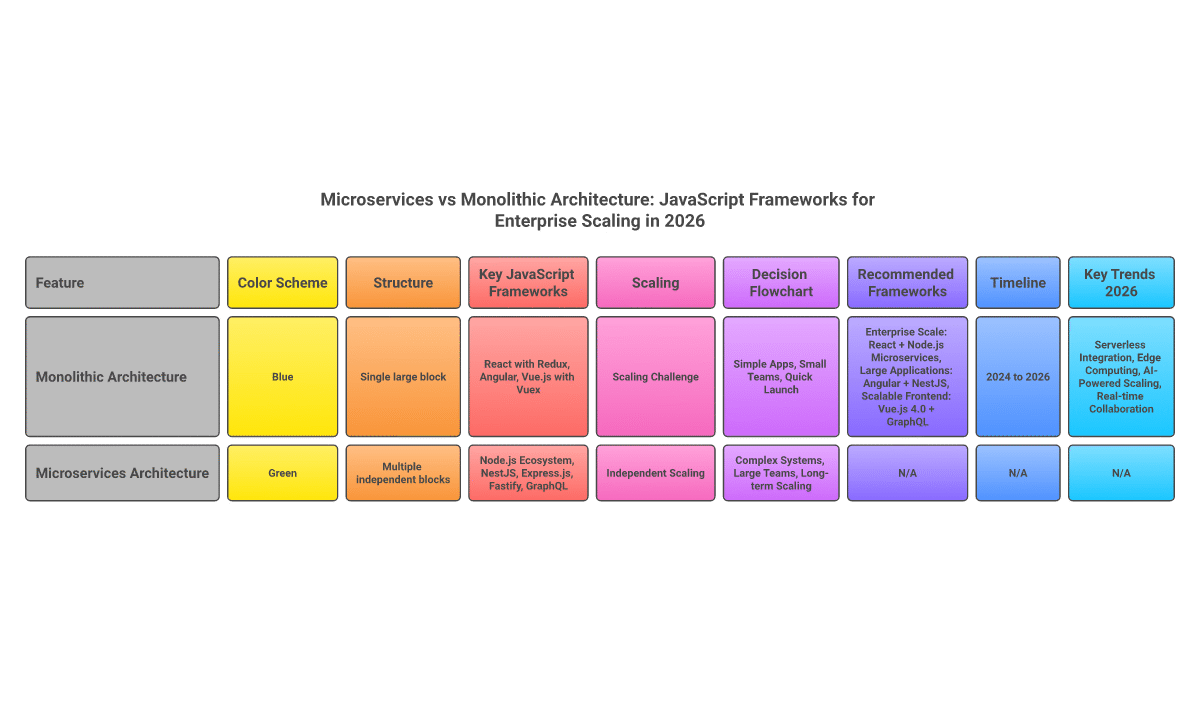
Your choice of JavaScript framework interacts significantly with your architectural approach. For microservices architectures, frameworks that support independent deployment and scaling of frontend components are ideal. React’s component-based architecture naturally aligns with microservices, allowing different teams to own specific components or features. Next.js’s API routes can serve as lightweight backend-for-frontend layers.
For monolithic architectures, frameworks with strong conventions and built-in solutions like Angular or full-stack frameworks like Next.js with Remix provide more structure and consistency. These frameworks help maintain code quality and prevent fragmentation in large codebases. The key is to choose a framework that supports your architectural goals while providing the flexibility to adapt as your application evolves.
Choosing Based on Project Requirements
Selecting the right JavaScript framework requires careful consideration of your specific project requirements. For applications requiring maximum performance and smallest bundle sizes, consider Svelte or Vue. For large teams needing structure and consistency, Angular provides the most comprehensive solution. For applications requiring flexibility and a vast ecosystem, React with Next.js remains the safest choice.
Consider your team’s existing skills—transitioning to a new framework has significant costs. Evaluate your application’s complexity—simple applications might not need the overhead of enterprise frameworks. Assess your scalability requirements—some frameworks handle large-scale applications better than others. Finally, consider long-term maintenance—choose frameworks with strong corporate backing and active communities to ensure ongoing support and development.
Future Trends and 2026 Predictions
Looking toward 2026, several trends will shape enterprise JavaScript framework selection. Server components will become more prominent, blurring the lines between frontend and backend development. Edge computing will influence framework design, with increased focus on edge rendering capabilities. WebAssembly integration will enable new performance optimizations and language interoperability.
Framework consolidation is likely, with fewer but more comprehensive solutions dominating the enterprise space. AI-assisted development tools will become integrated into framework ecosystems, improving developer productivity. Sustainability considerations will influence framework design, with increased focus on energy-efficient rendering and data transfer optimizations. Staying aware of these trends will help you choose frameworks that remain relevant through 2026 and beyond.
<------------------------------------------------>
JavaScript Frameworks for Enterprise Applications
Best JavaScript frameworks 2026
Enterprise JavaScript frameworks
Frontend frameworks for large applications
Enterprise web development frameworks
React enterprise applications
Angular vs React 2026