Building a fast, reliable, and scalable web application starts with choosing the right backend framework. As user expectations grow and digital products become more complex, developers need powerful tools that simplify development, improve performance, and handle massive traffic loads effortlessly.
In this guide, we’ll explore the top 10 backend frameworks for building scalable web apps in 2025.
Whether you’re a startup founder, backend engineer, or tech decision-maker, this list will help you choose the framework that best fits your goals.
What Are Backend Frameworks?
Before diving in, let’s clarify what backend frameworks are and why they matter.
A backend framework provides the foundation for building server-side applications. It handles database operations, server configuration, API routing, authentication, and more — essentially everything that happens behind the scenes of a web app.
The right framework can:
- Improve performance and scalability
- Speed up development with prebuilt tools and libraries
- Simplify API integration and middleware setup
- Enforce security best practices
- Support long-term maintainability
Choosing a backend framework isn’t just a technical decision — it’s a business one. The framework you select directly impacts your web app’s scalability, time-to-market, and ability to handle future growth.
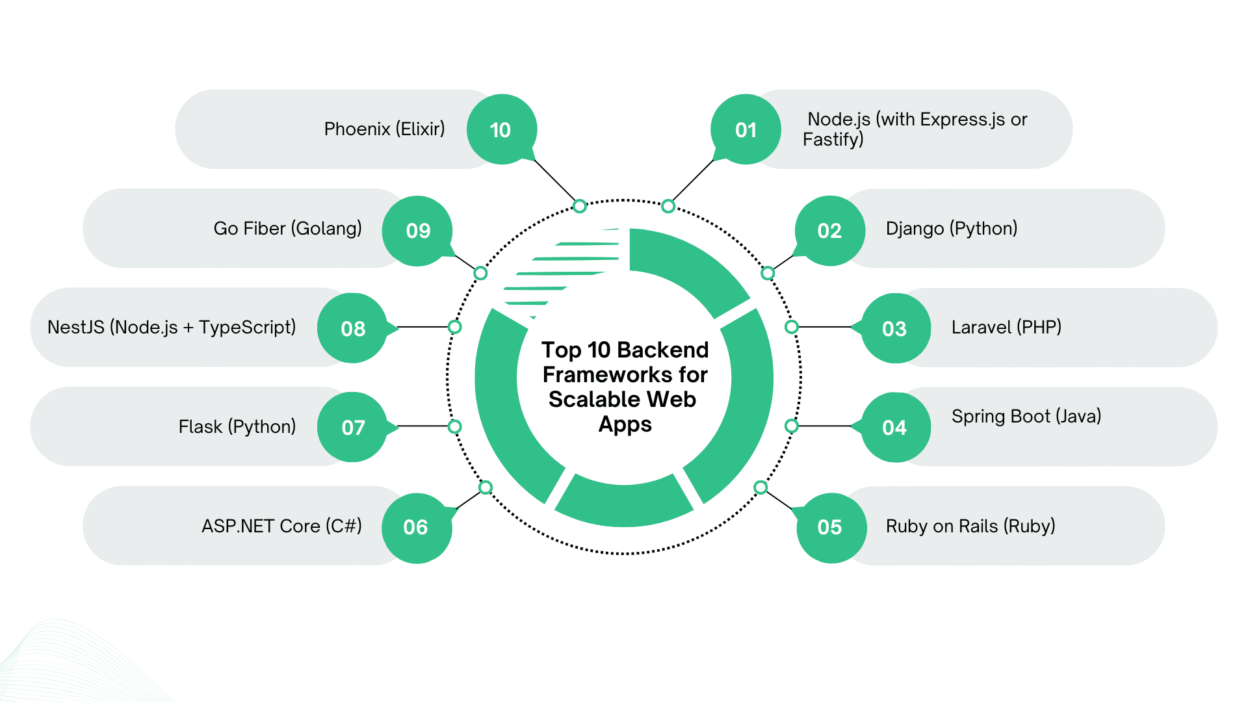
Top 10 Backend Frameworks for Scalable Web Apps
Let’s explore the frameworks that are powering the modern web in 2025.
1. Node.js (with Express.js or Fastify)
Best for: Real-time apps, APIs, and microservices
Why it stands out:
Node.js remains one of the most popular backend environments thanks to its non-blocking, event-driven architecture. It allows developers to build lightning-fast and scalable applications, particularly for real-time features like chats, notifications, and streaming.
Express.js, a minimalistic framework for Node.js, offers simplicity and flexibility — making it great for small to medium apps. For even better performance, Fastify has gained traction with its low overhead and optimized routing.
Key features:
- Event-driven and asynchronous architecture
- Massive npm ecosystem
- Ideal for microservices and serverless architectures
- Scales easily with load balancing
Notable users: Netflix, Uber, PayPal, LinkedIn
2. Django (Python)
Best for: Rapid development and enterprise-scale applications
Why it stands out:
Django is a high-level Python framework known for its “batteries-included” philosophy. It provides everything from authentication and ORM to admin panels right out of the box.
It’s ideal for developers who want to build secure, scalable web apps quickly without reinventing the wheel. Django’s clean architecture and built-in tools make it a go-to choice for startups and enterprises alike.
Key features:
- Built-in ORM, admin dashboard, and authentication
- Strong security features (CSRF, XSS protection, etc.)
- Excellent documentation and large community
- Scalable architecture with caching and load balancing
Notable users: Instagram, Pinterest, Mozilla
3. Laravel (PHP)
Best for: Elegant, full-featured web applications
Why it stands out:
Laravel has transformed PHP development with its elegant syntax and developer-friendly approach. It offers a modern toolkit for routing, caching, sessions, and authentication, making it perfect for teams that value rapid development and clean code.
Its ecosystem includes Horizon, Forge, and Vapor, enabling seamless deployment, queue management, and serverless hosting.
Key features:
- MVC architecture
- Built-in task scheduling and caching
- Scalable through microservices and queues
- Excellent documentation and large ecosystem
Notable users: 9GAG, Pfizer, BBC
4. Spring Boot (Java)
Best for: Enterprise-grade applications and microservices
Why it stands out:
Built on top of the Spring framework, Spring Boot simplifies Java backend development by minimizing boilerplate code and offering ready-to-use configurations. It’s designed for building production-ready applications with high scalability and robustness.
Spring Boot’s modularity and strong integration with cloud-native tools make it a perfect choice for large-scale, distributed systems.
Key features:
- Auto-configuration for fast setup
- Highly scalable microservice architecture
- Strong integration with databases and cloud providers
- Comprehensive security module (Spring Security)
Notable users: Netflix, eBay, Amazon
5. Ruby on Rails (Ruby)
Best for: Startups and rapid prototyping
Why it stands out:
Ruby on Rails emphasizes convention over configuration, which allows developers to build fully functional web apps in record time. Despite being over a decade old, it remains relevant due to its strong community and continual updates.
It’s a great option for startups or MVPs that need to go from idea to deployment quickly while maintaining scalability through caching and modularization.
Key features:
- Convention-over-configuration design
- Built-in testing framework
- Excellent community support
- Scales effectively with background jobs and caching layers
Notable users: Shopify, GitHub, Basecamp
6. ASP.NET Core (C#)
Best for: Enterprise web apps and high-performance APIs
Why it stands out:
Developed by Microsoft, ASP.NET Core is a cross-platform, open-source framework built for modern, cloud-based web applications. Its performance is among the best in the industry, making it ideal for large-scale enterprise apps and high-traffic systems.
It supports microservices architecture, dependency injection, and full integration with Azure cloud services.
Key features:
- High performance with Kestrel web server
- Cross-platform (Windows, Linux, macOS)
- Built-in dependency injection
- Strong security and authentication support
Notable users: Stack Overflow, GoDaddy, DocPlanner
7. Flask (Python)
Best for: Lightweight, modular applications and APIs
Why it stands out:
Flask is a micro-framework for Python that offers simplicity and flexibility. Unlike Django, it doesn’t impose a specific project structure, allowing developers to choose their own components.
Flask is perfect for smaller applications, REST APIs, or microservices that need to scale horizontally.
Key features:
- Minimalist design
- Easy integration with libraries and extensions
- Suitable for serverless architectures
- Excellent for prototyping and scaling gradually
Notable users: Netflix, Reddit, Lyft
8. NestJS (Node.js + TypeScript)
Best for: Scalable, enterprise-grade server-side applications
Why it stands out:
NestJS combines the power of Node.js with the structure and type safety of TypeScript. It uses a modular architecture similar to Angular, making it excellent for building large, maintainable systems.
Its built-in support for GraphQL, WebSockets, and microservices makes it one of the most modern backend frameworks available.
Key features:
- TypeScript-based structure
- Modular and testable architecture
- Integrated support for GraphQL and microservices
- Ideal for large-scale enterprise systems
Notable users: Adidas, Autodesk, Roche
9. Go Fiber (Golang)
Best for: High-performance, low-latency applications
Why it stands out:
Built on Golang, Fiber is inspired by Express.js but optimized for Go’s speed and concurrency. It’s designed for developers who want blazing-fast backend performance and minimal resource usage.
Fiber is particularly suited for APIs, real-time systems, and applications handling millions of requests per second.
Key features:
- Extremely fast and lightweight
- Easy to learn for Node.js developers
- Built-in middleware support
- Scales effortlessly on cloud and container platforms
Notable users: Uber, Twitch, Dropbox
10. Phoenix (Elixir)
Best for: Real-time, fault-tolerant web applications
Why it stands out:
Phoenix, built on the Elixir language and the Erlang VM, is known for its unmatched fault tolerance and real-time capabilities. It’s used in systems that demand high concurrency, like messaging apps or live dashboards.
Thanks to the BEAM virtual machine, Phoenix can handle millions of connections simultaneously without performance loss.
Key features:
- Real-time communication with channels
- Built on Erlang’s fault-tolerant ecosystem
- Ideal for distributed, scalable systems
- Great performance and concurrency support
Notable users: Discord, Bleacher Report, PepsiCo
How to Choose the Right Backend Framework
Here are a few factors to consider when choosing the right backend framework for your project:
- Project Requirements:
Complex enterprise systems may benefit from Spring Boot or ASP.NET Core, while smaller projects may prefer Flask or Laravel. - Performance Needs:
For high-traffic applications, consider Node.js, Go Fiber, or Phoenix due to their scalability and concurrency features. - Team Expertise:
Choose a framework that matches your team’s skills. For instance, Python teams may gravitate toward Django or Flask, while TypeScript developers might prefer NestJS. - Ecosystem & Community:
A strong ecosystem means more plugins, better documentation, and faster troubleshooting. - Long-Term Scalability:
Opt for frameworks that support modular architecture, microservices, and cloud integration to future-proof your app.
Final Thoughts
Choosing the right backend framework can define the success of your web app — not just technically, but strategically. Each of the frameworks above offers unique strengths: Django for rapid development, Node.js for real-time scalability, Spring Boot for enterprise resilience, and Phoenix for concurrency.
In 2025, scalability is not a luxury — it’s a necessity. The best backend frameworks help you build systems that grow effortlessly with your user base, ensuring top performance, security, and maintainability.
Whether you’re launching a startup or scaling an enterprise platform, investing time in selecting the right framework will pay off in long-term reliability and success.