
The internet is evolving again — and this time, it’s not just faster or smarter. It’s fundamentally changing how data, ownership, and trust work online. This next stage, known as Web 3.0, represents the next internet revolution, shifting power from centralized platforms to users themselves.
For businesses, this isn’t just a tech upgrade — it’s a strategic inflection point. As blockchain, AI, and decentralization converge, companies that adapt early will gain an edge in transparency, security, and customer loyalty.
In this article, we’ll explore what Web 3.0 really means, how it differs from Web 2.0, the technologies behind it, and — most importantly — what business leaders must do to prepare.
What Is Web 3.0?
Web 3.0, also known as the decentralized web, is the third generation of internet evolution. It aims to make the web open, trustless, and user-owned, powered by technologies like blockchain, smart contracts, and AI.
To understand the leap, let’s recap the journey:
| Web Era | Core Idea | Who Controls Data | Key Examples |
|---|---|---|---|
| Web 1.0 (1990s–early 2000s) | Static content and read-only websites | Website owners | Yahoo, Netscape |
| Web 2.0 (2004–present) | Interactive, user-generated content and platforms | Centralized companies | Facebook, Google, YouTube |
| Web 3.0 (Now emerging) | Decentralized, user-owned, tokenized ecosystems | Users and communities | Ethereum, IPFS, DAOs |
In short, Web 1.0 was read-only, Web 2.0 became read-write, and Web 3.0 is read-write-own.
Why Web 3.0 Matters for Businesses
Web 3.0 isn’t just about cryptocurrencies or NFTs — it’s about rebuilding digital trust and ownership. For businesses, this shift will impact everything from customer relationships to data management and brand transparency.
Here’s why it matters:
- Ownership and Control – Customers will control their own data through digital wallets and decentralized identities. Companies must rethink personalization without invading privacy.
- New Business Models – Web 3.0 enables tokenized ecosystems, where users become stakeholders through reward systems or governance rights.
- Transparent Supply Chains – Blockchain-based traceability will redefine how brands prove authenticity and sustainability.
- Resilient Infrastructure – Decentralized networks reduce the risks of single points of failure or censorship.
In essence, Web 3.0 is about trust and participation, not extraction. Businesses that align with this new ethos will win in the long run.
The Core Technologies Powering Web 3.0
Understanding Web 3.0 starts with understanding its technology pillars. These aren’t buzzwords — they’re the foundations of a more intelligent and decentralized internet.
1. Blockchain
At its heart, blockchain is a distributed ledger that ensures transparency and immutability. Every transaction or record is verified by a network of participants instead of a central authority.
- Business use cases:
Supply chain tracking, digital identity management, smart contracts for automation, and token-based loyalty programs.
2. Smart Contracts
These are self-executing agreements written in code. They automatically enforce terms when conditions are met — no intermediaries required.
- Example: A company could pay freelancers instantly after task completion verified on the blockchain — removing delays and disputes.
3. Decentralized Applications (dApps)
Unlike traditional apps hosted on centralized servers, dApps run on blockchain networks. They’re open-source and governed by communities rather than corporations.
- Examples: Uniswap (finance), Lens Protocol (social), Filecoin (storage).
4. Artificial Intelligence and Semantic Web
AI enables the web to understand context, not just keywords. Combined with decentralized data, this allows for personalized yet privacy-preserving experiences.
- Example: AI-powered search engines that interpret meaning rather than matching words — giving more accurate and useful results.
5. Edge Computing & Interoperability
Instead of relying on big data centers, Web 3.0 uses distributed nodes closer to users. This boosts speed, reduces latency, and supports cross-platform interoperability.
Key Differences Between Web 2.0 and Web 3.0
| Feature | Web 2.0 | Web 3.0 |
|---|---|---|
| Ownership | Centralized by platforms | Decentralized and user-owned |
| Data Storage | Cloud servers | Distributed networks (blockchain/IPFS) |
| Monetization | Ads and subscriptions | Tokens and decentralized finance |
| Trust Model | Based on intermediaries | Based on cryptography |
| User Identity | Email-based accounts | Self-sovereign identity (wallets) |
| Governance | Controlled by companies | Managed by community (DAOs) |
How Web 3.0 Impacts Different Industries
1. Finance (DeFi Revolution)
Decentralized Finance (DeFi) removes banks from the equation, offering peer-to-peer lending, payments, and insurance. Traditional banks are now exploring hybrid models combining compliance with blockchain transparency.
2. Retail and E-Commerce
NFT-based ownership certificates and blockchain-verified supply chains will become trust signals. Brands can build stronger connections with consumers through loyalty tokens or digital collectibles.
3. Marketing and Advertising
Web 3.0 ends the era of intrusive data tracking. Instead, privacy-first targeting and user-consented data sharing will dominate. Companies must build communities, not audiences.
4. Media and Content Creation
Creators gain direct ownership of their content through NFTs and decentralized publishing. No more dependency on ad-driven platforms for monetization.
5. Healthcare
Secure patient records stored on blockchain will streamline sharing while maintaining privacy — a major leap for compliance and trust.
Preparing Your Business for the Web 3.0 Transition
Transitioning to Web 3.0 doesn’t mean abandoning current systems overnight. It’s about evolving gradually while aligning strategy, technology, and culture.
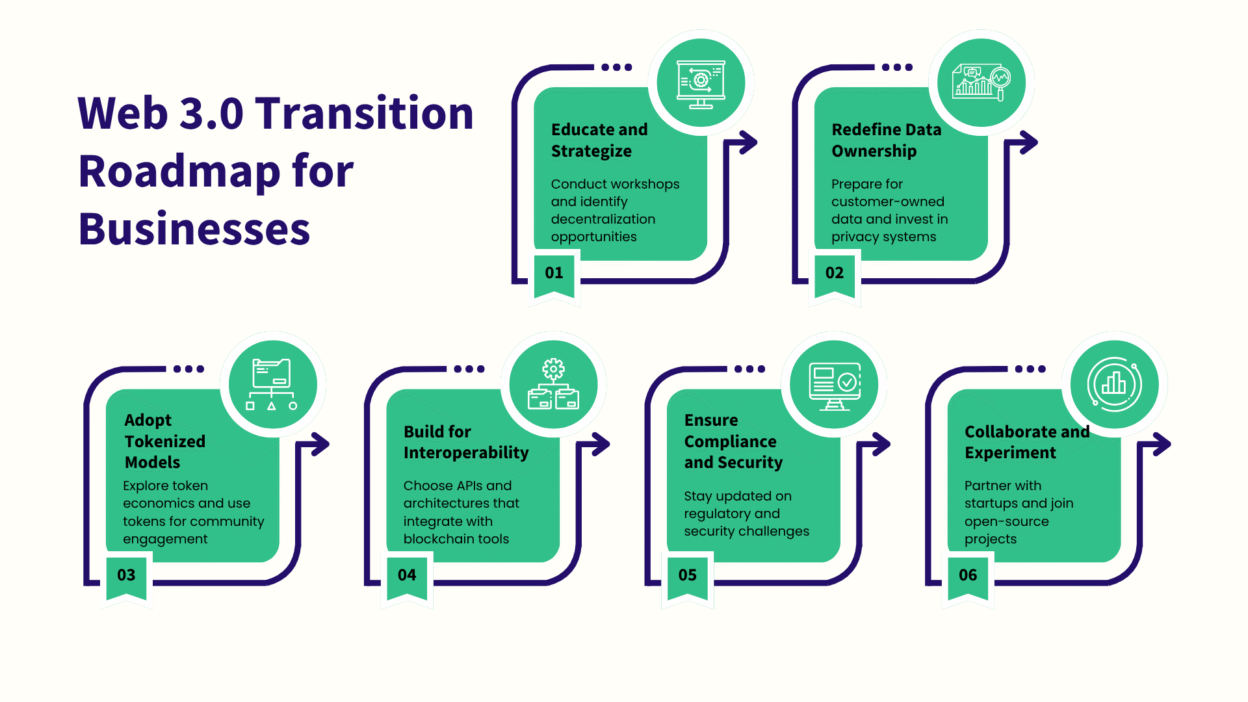
Here’s a roadmap to get started:
1. Educate and Strategize
- Conduct internal workshops on blockchain, AI, and decentralized models.
- Identify where decentralization can add transparency or efficiency.
- Start with a pilot project (e.g., blockchain-based customer rewards).
2. Redefine Data Ownership
- Prepare for a future where customers own and share their data selectively.
- Invest in consent-based data systems and privacy-preserving analytics.
3. Adopt Tokenized Models
- Explore token economics — from loyalty points on blockchain to DAO-style community engagement.
- Tokens can increase retention by turning users into stakeholders.
4. Build for Interoperability
- Avoid closed ecosystems; choose APIs and architectures that integrate easily with blockchain-based tools.
- Use standards like W3C DID (Decentralized Identifiers) for user authentication.
5. Ensure Compliance and Security
- Web 3.0 introduces new regulatory and security challenges.
- Stay updated on evolving frameworks around digital assets, smart contracts, and data privacy.
6. Collaborate and Experiment
- Partner with blockchain startups or innovation labs.
- Join open-source projects or decentralized networks to test use cases before full-scale adoption.
The Business Benefits of Early Web 3.0 Adoption
Companies embracing Web 3.0 early will enjoy competitive advantages beyond technology:
- Customer Trust: Transparent data use builds loyalty.
- Efficiency: Automated, smart contracts cut operational costs.
- New Revenue Streams: Tokenized ecosystems and digital assets unlock new monetization models.
- Innovation Reputation: Being seen as a Web 3.0 pioneer attracts talent and investors.
Challenges to Overcome
Of course, the path isn’t without obstacles. Businesses must navigate:
- Technical complexity – integrating blockchain with legacy systems.
- Regulatory uncertainty – global laws on tokens and data vary widely.
- User adoption barriers – most consumers are still unfamiliar with Web3 wallets or decentralized identities.
- Scalability issues – blockchains must handle enterprise-grade transaction volumes.
The Future of Business in the Web 3.0 Era
By 2030, the web will look vastly different. Centralized control will give way to community-driven ecosystems. Data will become portable, transparent, and secure. Businesses won’t just serve users — they’ll co-create value with them.
Imagine this:
- A retail brand rewarding loyal customers with digital tokens they can trade or stake.
- A global workforce coordinated through decentralized organizations (DAOs).
- A marketing campaign that respects privacy yet delivers hyper-relevant experiences through user-consented data.
Conclusion: Preparing for the Next Internet Revolution
The Web 3.0 revolution is more than a trend; it’s the natural evolution of the internet toward fairness, transparency, and shared value. For businesses, preparation means more than adopting new tech — it means embracing a new mindset of collaboration, trust, and digital empowerment.
As blockchain, AI, and decentralization mature, the businesses that act now will define the standards of tomorrow’s web.